Blog · 30 Oct 2026 · By BitcoinSaving
The Weimar hyperinflation: what happened to savers
Maximilian Bern was a retired writer in Berlin. He had saved carefully all his life. In 1923 he went to his bank and withdrew everything: 100,000 marks. Before the war, that sum would have funded a comfortable retirement. That day, it bought him one subway ticket. He rode the train around the city one last time. Then he went home, locked his door, and starved. His story, retold in Frederick Taylor's history of the collapse, is what the Weimar hyperinflation did to savers, in one life.
Try it on your own numbers
The BitcoinSaving app replays any amount, rhythm and start year on real prices back to 2010, with charts for your average cost and your stretches under water. The iPhone beta opens soon.
Free during the beta. Leave your email on the download page and the invite lands the moment it opens.
One short email a week
A real savings story, the numbers behind it, in plain words. Plus first access when the app launches.
A money people trusted
Before 1914, the German mark was boring. Boring was good.
One US dollar cost 4.2 marks. That rate had held for decades. The mark was backed by gold, and Germans trusted it the way you trust a floor.
So they saved. They put money in savings banks. They bought insurance policies. They bought government bonds. Saving was a national habit, and for two generations it had worked.
Almost none of that money survived the next ten years.
Step one: a war paid for with borrowed money
In August 1914, Germany went to war and quietly took the mark off gold. The government chose not to pay for the war with taxes. Taxes are unpopular. Borrowing is quiet.
The plan assumed a quick win. The losers would pay the bill. Germany lost.
By 1918 the state owed 156 billion marks. The amount of paper money in circulation had risen more than fivefold during the war. Prices had more than doubled. The mark had slipped from 4.2 to about 8 per dollar.
That was the warning. Almost nobody read it that way at the time. Inflation after a war felt like a hangover. People expected it to fade.
Step two: the reparations bill
Then came the peace terms. The Treaty of Versailles blamed Germany for the war and sent it the bill.
In 1921 the total was fixed at 132 billion gold marks. The key word is gold. Reparations had to be paid in gold or in foreign money, not in paper marks.
To get dollars, the government sold marks. Selling marks by the truckload pushed the mark's price down. A falling mark made the next payment even harder. It was a trap with no clean exit.
Step three: the printing press becomes the budget
The new republic had promises to keep. Pensions for veterans. Payments to widows and orphans. Wages for a large state. Its tax income covered only a part of it. From April 1920 to March 1921, taxes covered just 37 percent of spending.
The gap was filled by the Reichsbank, the central bank. It printed the difference. Each new batch of notes made every existing note worth a little less. So the government needed to print even more to raise the same real amount.
This is the engine of every hyperinflation. Print to cover the gap. The printing makes the gap bigger. Print faster.
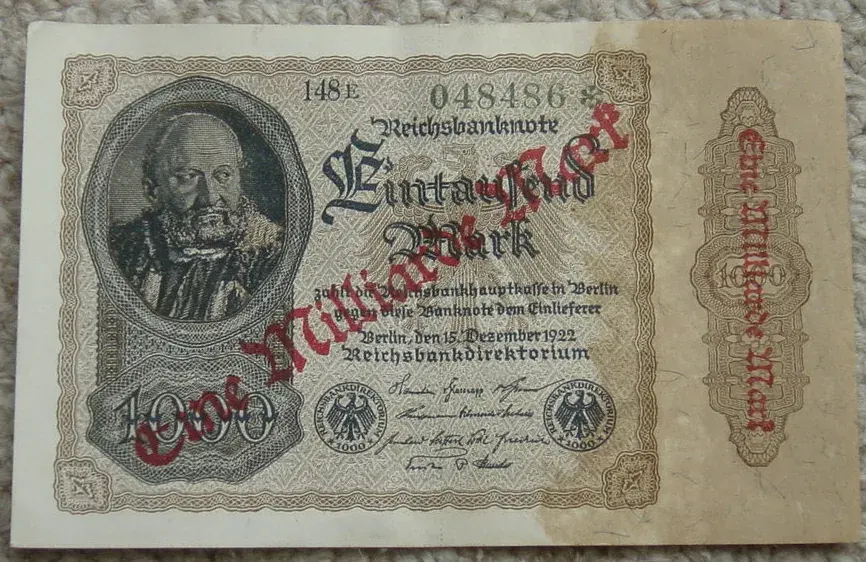
The slide turned into a fall. Here is the price of one US dollar, in marks:
| Date | Marks per US dollar |
|---|---|
| 1914 | 4.2 |
| Late 1919 | 48 |
| Mid 1922 | 320 |
| December 1922 | 7,400 |
| November 1923 | 4,200,000,000,000 |
The fall of the mark against the dollar. Sources listed at the end of this article.
1923: the Ruhr, and the final spiral
In January 1923, French and Belgian troops occupied the Ruhr, Germany's industrial heartland. They came to seize coal and goods in place of unpaid reparations.
The German government told Ruhr workers to resist by not working. It promised to keep paying them anyway. With what? Printed money.
The presses now ran day and night. More than 30 paper mills made the banknote paper. Around 150 printing firms ran some 2,000 presses. Making money had become one of the country's biggest industries.
Daily life when money melts
A loaf of bread cost about 0.29 marks in 1918. By the end of 1922 it cost about 160 marks. By November 1923 it cost 200 billion marks.
Workers were paid twice a day. They ran to the shops on their lunch break, because money held until evening bought less. Wives waited at factory gates to grab the pay packet and spend it within the hour.
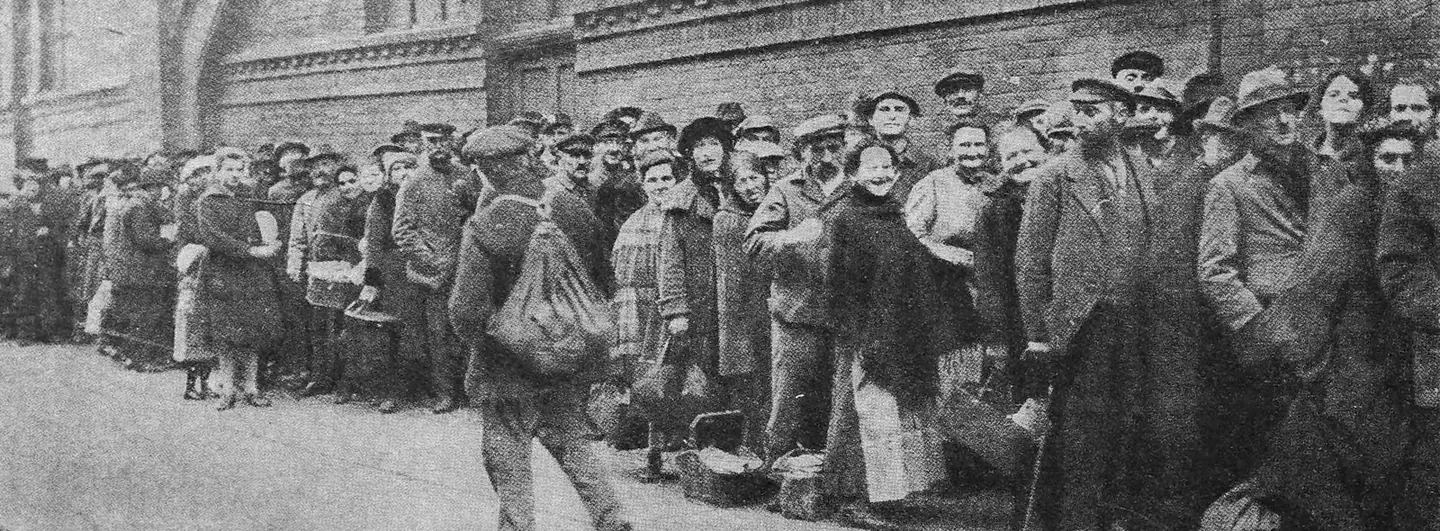
Shopping needed luggage. People carried cash in laundry baskets, suitcases and wheelbarrows. One famous story tells of a thief who stole the wheelbarrow and left the money on the pavement. The barrow was worth more.
At home, banknotes went into the stove. A bundle of marks burned longer than the firewood it could buy. Notes were pasted on walls as decoration. They were cheaper than wallpaper.
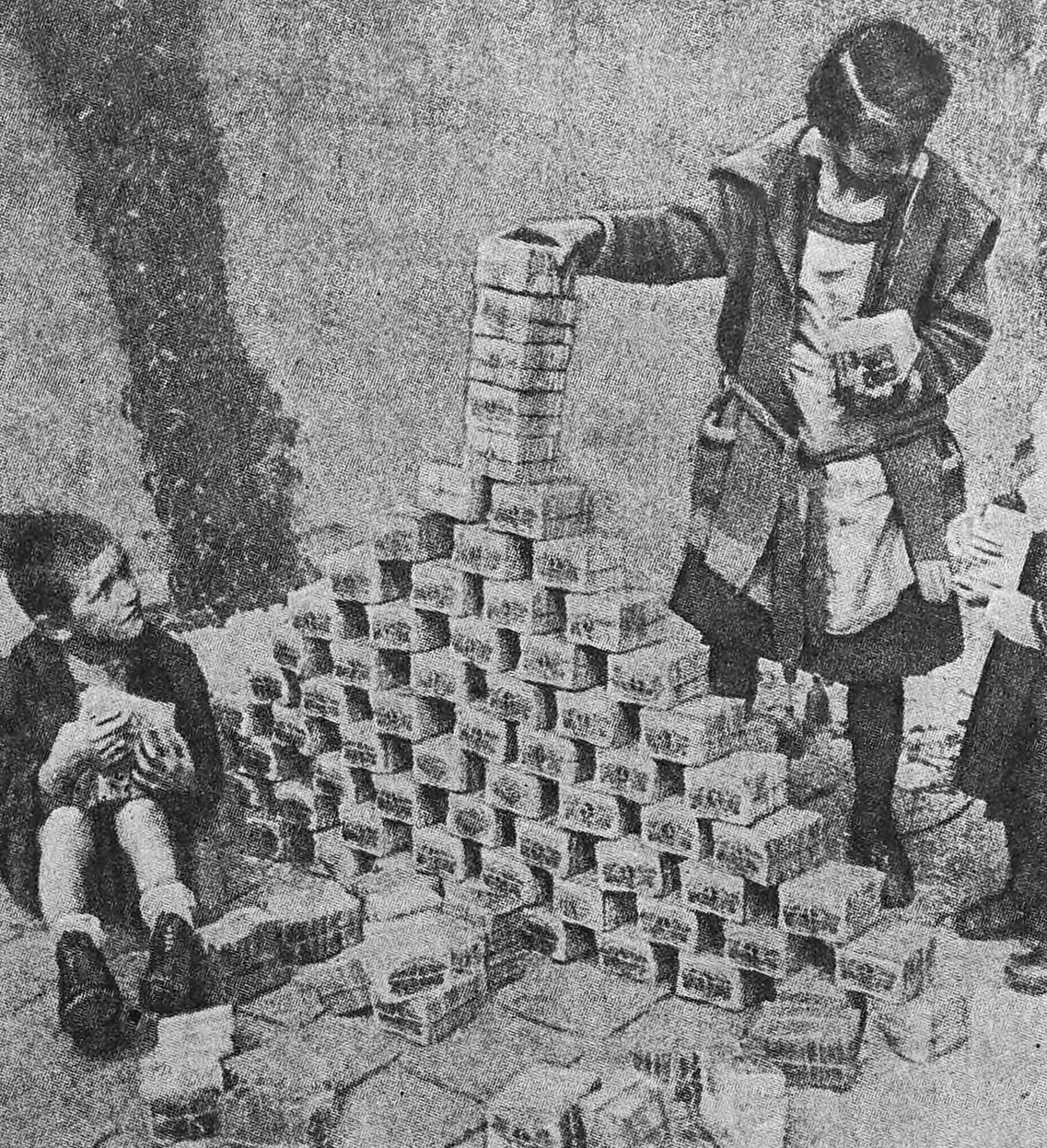
Farmers stopped accepting paper for food. City families travelled to the countryside with pianos, carpets and jewellery, hoping to trade them for potatoes and eggs. Money, the tool everyone had organised their lives around, simply stopped working.
Towns and companies started printing their own emergency money, called Notgeld. Thousands of local versions appeared. Some were beautiful. Some were jokes printed on paper, mocking the whole situation. None of it fixed the real problem. There were still no limits on how much money could exist.
The worst month
October 1923 was the peak. Prices rose about 29,500 percent in that single month, according to the Hanke-Krus table of world hyperinflations. Prices were doubling roughly every 3.7 days.
Think about what that does to a normal week. A price agreed on Monday is a joke by Friday. A pension paid on the first of the month buys almost nothing by the tenth. Saving for anything, even a week ahead, becomes impossible.
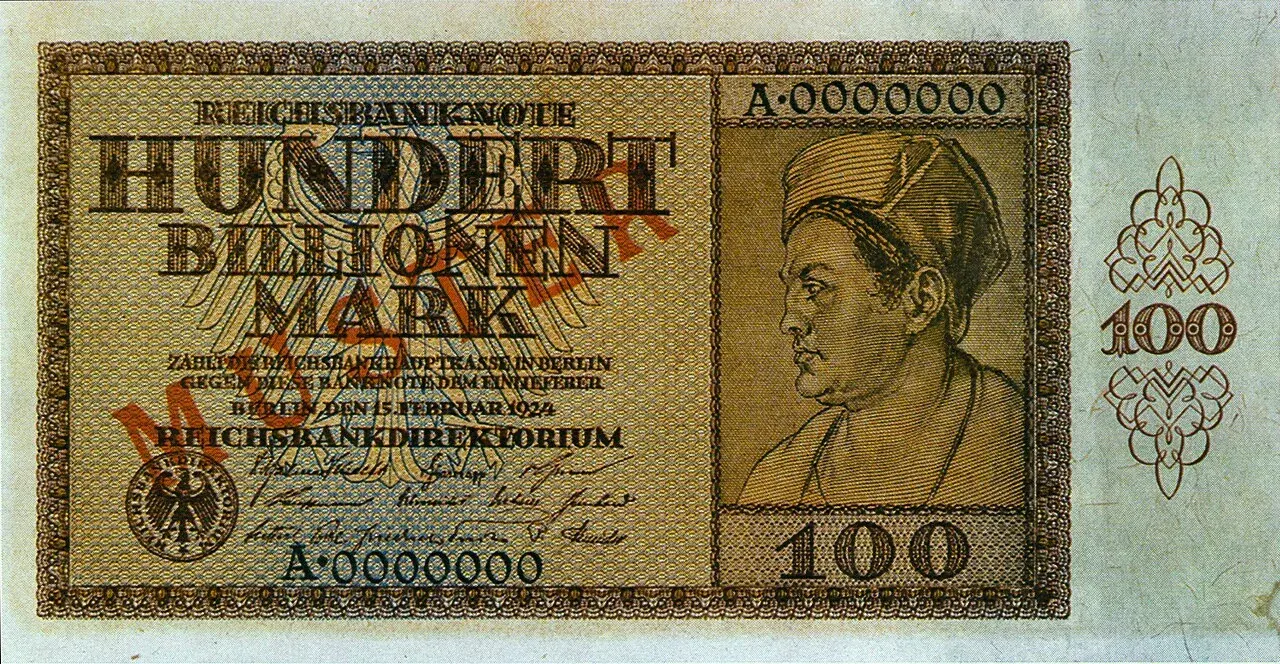
By late November, one dollar cost 4.2 trillion marks. Unemployment jumped above 20 percent as businesses failed. The money was dead. What remained was to bury it.
The fix: cut off twelve zeros
On 15 November 1923, Germany introduced a new money: the Rentenmark. It was said to be backed by mortgages on the country's land and factories.
The backing was mostly a story. Nobody could walk in and swap a note for a field. What actually worked was the limit. The new bank was not allowed to print freely, and the Reichsbank stopped printing money to fund the government. Finance minister Hans Luther and currency commissioner Hjalmar Schacht held that line.
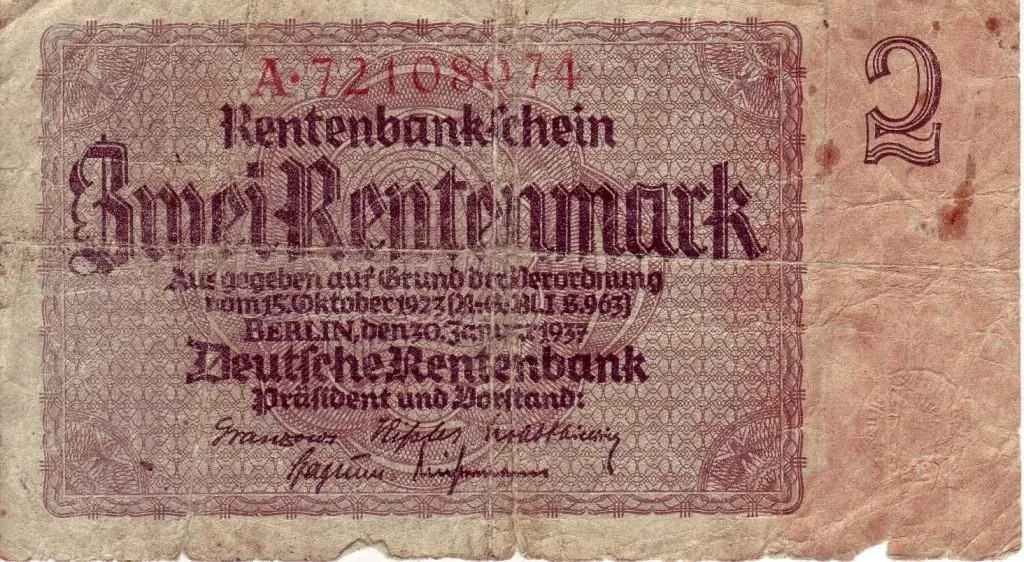
The exchange was brutal and simple. One trillion paper marks became one Rentenmark. Twelve zeros, gone. And the dollar rate was set at 4.2 Rentenmarks. Exactly where it had stood in 1914.
Prices stopped rising almost at once. People called it the miracle of the Rentenmark. It was not a miracle. The presses had simply been switched off.
The bill landed on savers
Hyperinflation does not destroy wealth evenly. It moves it. In Weimar Germany, it moved wealth from people who had saved to people who owed.
The losers were the careful ones. Savings accounts shrank to nothing. Pensions fixed in marks became worthless. Insurance policies, paid into for decades, settled for sums that would not buy a meal. War bonds, bought out of patriotism, were repaid in confetti.
The winners were the debtors. A mortgage that once equalled the value of a house could be repaid with the price of a tram ticket. Industrialists like Hugo Stinnes borrowed marks, bought mines, factories and ships, then repaid the loans in worthless paper. He built an empire out of other people's melting money.
The biggest debtor of all was the German state. Its 156 billion marks of war debt, a crushing burden in 1919, quietly evaporated. A law in 1925 later gave some mortgage lenders back 25 percent of face value. For most savers, that was too little, and years too late.
The wound lasted longer than the inflation. A whole generation had done everything right: worked, saved, planned, trusted. They were wiped out anyway, while speculators and big borrowers got rich. Germans remembered that lesson for decades. It is one reason the country still treats sound money and independent central banks as sacred.
What Weimar teaches a saver
First lesson: cash is a promise, and promises depend on limits. The mark did not fail because Germans forgot how to work or save. It failed because the people issuing it removed every limit on how much of it could exist.
Second lesson: the real risk is not this year's prices. It is the unit itself. A saver can survive prices rising 5 percent a year. Nobody can plan when the measuring stick doubles in length every four days.
Third lesson: inflation is a transfer, not an accident. Every mark of debt that melted away in 1923 had a saver on the other side of it. The loss was silent, legal, and total.
Fourth lesson: what survived was what nobody could print. Land kept its value. Businesses kept their value. Gold and foreign money kept their value. Skills kept their value. Paper claims on the state did not.
That last lesson is why this site exists. Bitcoin was designed with the opposite rule to the Papiermark: a supply capped at 21 million coins, fixed in advance, that no government or bank can vote higher. That does not make Bitcoin safe. Its price has fallen hard, more than once, and it will scare anyone who watches it daily. But its supply cannot be printed away, and that is the specific failure that destroyed Germany's savers.
If you want the saver side of the story in more depth, our learn guides cover how steady, small purchases behave over long periods, using real past prices. And our DCA calculator shows what regular buying would have done across Bitcoin's own history, crashes included.
Related stories
What $100 became in 10 years
Cash, gold, stocks and Bitcoin given the same $100 and the same decade: the modern, slower version of the savers' problem.
Bitcoin savings vs a bank account
$100 a month for five years, started at the all-time high: the bank's safety against Bitcoin's swings, with the bad years left in.
Run your own numbersMore stories
Sources and further reading
- Thorsten Polleit, The End of German Hyperinflation (Mises Institute): the debt figures, the Rentenmark reform, and the lessons drawn by the Austrian school.
- How Hyperinflation Shattered German Society (Foundation for Economic Education): the collapse's effect on ordinary savers, including Maximilian Bern's story, from Frederick Taylor's The Downfall of Money.
- The Scariest Inflation Chart You've Ever Seen (Foundation for Economic Education): how fast ordinary inflation became hyperinflation, told through the price of a daily newspaper.
- Steve Hanke and Nicholas Krus, The Hanke-Krus World Hyperinflation Table (Cato Institute Working Paper No. 8): Germany's peak month, October 1923, at 29,500 percent, with prices doubling every 3.70 days.
Photos: Wikimedia Commons, public domain, as credited under each image.